I Love All My Family: Dad, Mom, Brother, Sister Review
As a designer who has spent years turning digital concepts into tangible stitched goods, I approach every new machine embroidery design with a mix of curiosity and skepticism. When I first opened the files for I Love All My Family Dad Mom Brother Sister, my immediate goal was to determine if this piece of Graphics could hold up under the scrutiny of a real-world production environment. It is not enough for a design to look good on a screen; it must translate seamlessly into thread, fabric, and a finished product that customers will cherish.
The First Impression: Warmth and Simplicity
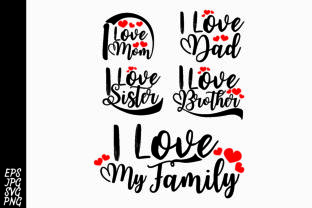
The visual personality of I Love All My Family Dad Mom Brother Sister is immediately inviting. The layout suggests a balanced composition where each family member is given equal weight, avoiding the clutter that often plagues multi-word designs. In the world of Crafts, simplicity is often the hardest thing to achieve without sacrificing character. This design manages to convey a deep emotional connection through clean lines and a straightforward message. It feels less like a generic clip art asset and more like a custom illustration ready for the hoop.
When I visualize this as an embroidery file, the mood it sets is one of nostalgia and comfort. It is the kind of design that belongs in a nursery, on a cozy kitchen apron, or as a heartfelt holiday gift. The lack of overly intricate detailing is a strategic advantage here. High-detail graphics can sometimes result in muddy stitching if the stitch density isn't perfectly calibrated, but this design appears robust enough to maintain clarity even when scaled down slightly.
A Real-World Scenario: The Custom Tote Bag Project
To truly test the viability of I Love All My Family Dad Mom Brother Sister, let’s imagine a specific project. I am preparing a line of personalized canvas tote bags for a local boutique. These bags are meant to be durable, everyday carryalls for families. I need a design that stands out against the natural beige canvas but doesn't overwhelm the user.
In this scenario, the design shines. The text elements "Dad," "Mom," "Brother," and "Sister" are distinct enough to be read from a distance, which is crucial for a tote bag. If I were to use this for sweatshirt embroidery, I would likely place it across the chest or on the back pocket. The versatility of the layout allows me to experiment with different thread colors. For a neutral bag, a vibrant coral or navy blue fill stitch would pop beautifully, while a soft pastel palette might work better for a baby item.
One of the most critical aspects of this design for a small business owner is its adaptability. As an Etsy seller, I know that customers love customization. With the included formats—JPG, EPS, SVG, and PNG—I have the flexibility to adjust the color scheme to match a client's specific request before sending it to the machine. This level of control is essential for maintaining brand consistency and ensuring high buyer engagement.
Navigating Technical Challenges and Fabric Choices
While the design is strong, every embroidery project comes with potential pitfalls that require careful management. One area where caution is needed is with textured fabrics. If you plan to use this design on a heavy fleece or a thick wool blend, the texture of the fabric can interfere with the running stitch and satin stitch edges, potentially making the lettering look jagged. In such cases, using a tear-away stabilizer of higher weight is non-negotiable to ensure the stitches lay flat.
Another consideration is the hoop size. While the design looks compact, always verify the actual dimensions against your machine's capabilities. Attempting to embroider this on a very small cap or a curved surface like a hat brim could distort the spacing between the words. If the design is too tight, the tension might pull the fabric, ruining the final look. For curved surfaces, breaking the design into smaller sections or adjusting the digitization might be necessary, though the current layout seems optimized for flatter surfaces like pillow covers or tea towels.
Dark fabrics present their own set of challenges. Without a proper backing or a top-stitch layer, light-colored threads might not show up clearly. Before committing to a dark garment, I always recommend testing the design on scrap fabric first. Check the contrast and ensure the stitch density is sufficient to cover the background completely without showing the fabric underneath.
Practical Notes for Designers and Makers
For those looking to incorporate I Love All My Family Dad Mom Brother Sister into their commercial workflow, there are several best practices to follow. First, never skip the test run. Stitching the design on a scrap piece of the same fabric you intend to use for the final product allows you to catch any issues with thread breaks, puckering, or misalignment.
Secondly, consider the context of the finished product. Is this going to be a personalized gift that needs to withstand frequent washing? If so, ensure the stabilizer is cut away cleanly and the thread quality is high to prevent fraying over time. For items like embroidered patches, the design's bold outlines make it a perfect candidate, provided the backing is sturdy enough to support the patch application.
Finally, always review the licensing terms. While the download includes multiple file formats suitable for various uses, confirm whether you are allowed to sell the digital embroidery file itself or only the physical products created with it. Understanding these boundaries protects your craft business and maintains professional integrity.
Final Verdict on Value and Appeal
In conclusion, I Love All My Family Dad Mom Brother Sister is a solid addition to any designer's library. It strikes a rare balance between emotional resonance and technical practicality. Whether you are creating custom apparel for a corporate event, crafting holiday embroidery gifts, or stocking shelves at a small shop, this design offers a reliable foundation for high-quality work.
Its ability to scale well, its clear typography, and its versatile aesthetic make it a safe yet impactful choice. By paying attention to fabric choice, stabilizer usage, and thread contrast, you can transform this design asset into a premium handmade product that customers will value. For designers who prioritize both aesthetics and functionality, this is a tool that delivers results without unnecessary complications.